

Microsoft has launched AI Performance in Bing Webmaster Tools, making Bing the first major search engine to provide reports on how often your website’s pages are cited in AI-generated answers across Microsoft Copilot, Bing AI summaries, and some of their partner integrations.
This is a welcome development for website managers wanting insights into how their web pages are performing within Microsoft’s AI experiences, giving a clearer view of which pages are being referenced and where opportunities exist to improve citations and coverage.
Currently, no other major platforms, including Google, ChatGPT, or Perplexity, offer their business users this level of insight into AI answer coverage.
Why has Microsoft released this?
Introduced on February 10, Microsoft’s AI team announced on the Bing Webmaster Tools blog that the new release is “an early step toward Generative Engine Optimization (GEO) tooling”, signalling their desire lead the way with transparency between AI systems and the open web.
Key metrics in the new reports
The AI Performance report introduces a set of new metrics that focus on citation visibility within AI-generated answers. This includes the following:
Total Citations & Average Cited Pages
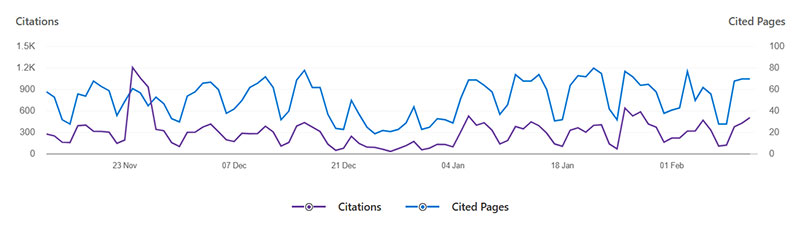
Total citations show the number of times your website has been referenced as a source within AI-generated answers during the selected date range. Each citation reflects an instance where your content was used to help ground or support an AI response.
Average cited pages reflect the average number of unique URLs from your site that were cited per day over the selected period. This provides a sense of how broadly your content is contributing to AI responses.

Grounding Queries
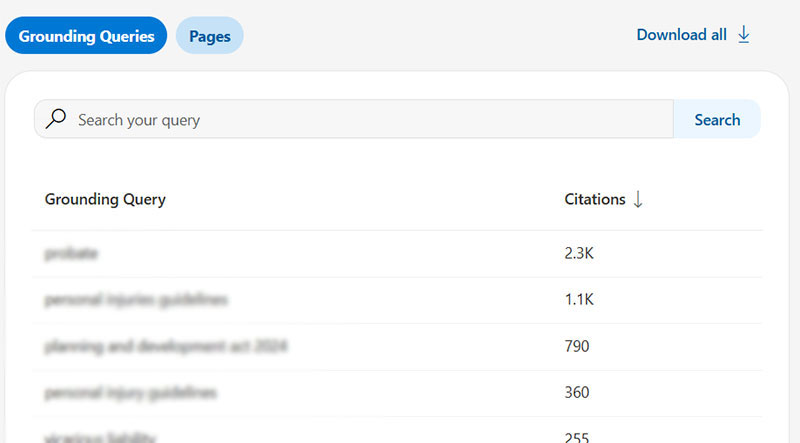
Grounding queries are one of the more interesting elements of the report. These are representative phrases associated with the retrieval process that led to your content being cited. In traditional SEO terms, they resemble keyword-level insight, but they are not identical to search queries entered by users.
Microsoft says the data in this part of the report is a sample of overall citation activity. That means it provides directional insight rather than a complete list of all triggering phrases. For website managers, grounding queries are useful for identifying themes and intent patterns that are influencing AI citations.
Page-Level Citation Activity
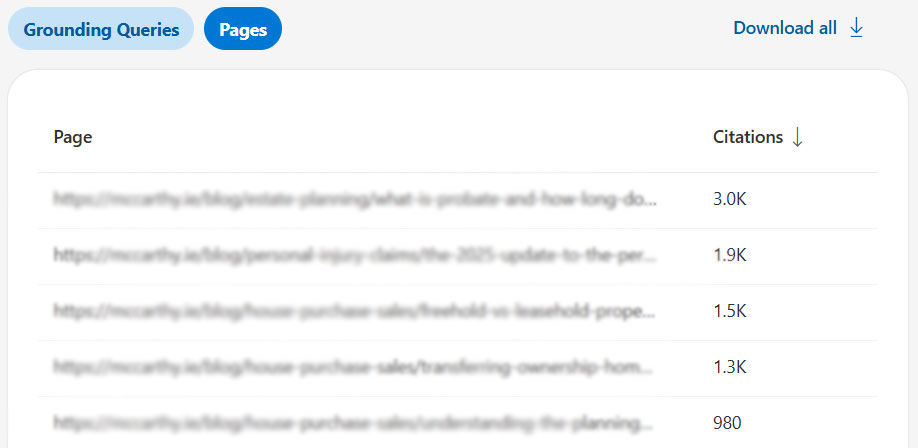
The report also provides citation counts at page level. This allows you to see which specific URLs are being referenced most frequently within AI answers.
This can be particularly useful for identifying high-value informational assets, pillar content, or authoritative guides that are resonating with AI systems.
Visibility Trends Over Time
Finally, the report includes trend data over time. This shows whether your citation activity is increasing, stable, or declining across supported AI experiences.
What the new reports do not provide
Microsoft states that it is committed to expanding the insights provided in its AI performance reports; however, the launch version of the feature does not offer any data on citation clicks or the CTR for any of the cited resources.
As AI-generated answers continue to dominate the space on traditional search engine results pages, and as more people use AI platforms like ChatGPT and Perplexity to research information, SEO consultants and website managers like me can only hope that other big players in the search space will follow Microsoft’s lead and make their AI performance data more readily available to their business users.
Require assistance with your AI search strategy?
If you are wondering how to go about increasing citations of your website content on AI platforms such as ChatGPT and Microsoft Copilot, I’d be happy to discuss some of the activities I have found most successful for helping my clients achieve stronger visibility in AI-generated results. Arrange a time to speak with me by completing my quick contact form.

0 Comments